When Florence Williams, a journalist, embarked on her journey to fully understand how nature benefits the human mind, she knew it wasn’t that we don’t appreciate nature: “It’s not the views we mischaracterize, it’s our responses to them. We walk right past magnificence all the time, not just because we’re busy, or because we don’t see it, but because we don’t realize what it does for our brains” (Williams, 123).
The Nature Fix: Why Nature Makes Us Happier, Healthier, and More Creative by Florence Williams is a nonfiction book exploring the specific benefits of nature. When The Nature Fix was first published in 2017, it quickly became an Audible bestseller.
Why You Should Read This Book
Florence Williams, a journalist and contributing editor at Outside Magazine specializes in writing about the environment, health, and science. She’s won several awards and her work has been featured in publications like National Geographic and the New York Times.
Eric Weiner from the Times reviewed: “I’m no tree hugger, but The Nature Fix made me want to run outside and embrace the nearest oak. Not for the tree’s sake but mine. Florence Williams makes a compelling, and elegant, case that nature is not only beautiful but also good for us. If Thoreau were steeped in modern neuroscience and possessed an endearingly self-deprecating sense of humor, the result would be the book you hold in your hands.”
I love that Eric Weiner likened this book to Henry Thoreau, because, while Williams makes quick, compelling observations, she does it with a poetic reverence. The Nature Fix is a testament to the scientists who have been quantifying exactly how nature helps our brain function. Williams interviews these scientists, travels the world, and explores different nature activities that people are using to heal or restore balance within themselves. It’s clear that her appreciation for nature runs deep, and so does her appreciation for these scientists. But she frames these observations in regard to how nature can make people happier, healthier, and more creative. Hopefully, if people realize why nature is so good for us, we’ll see it not as something to be exploited, but appreciated and respected. Our connection to nature is not a luxury, but an essential part of our humanity and health.
Key Takeaways from The Nature Fix
“Attention is our currency, and it’s precious” (Williams, 42).
In 1865, Frederick Law Olmstead argued that nature “‘employs the mind without fatigue and yet exercises it; tranquilizes it and yet enlivens it; and this, through the influence of the mind over the body, gives the effect of refreshing rest and reinvigoration to the whole system’” (Williams, 48).
But in the early 1980s, two professors from the University of Michigan noticed that psychological distress was often related to mental fatigue. After doing some research and experimentation, Rachel and Stephan Kaplan developed the Attention Restoration Theory. ART attests that people can concentrate better after spending time in nature. An important concept I want to bring up right now is “the nature pyramid,” developed by Tim Beatley. Think of it similar to the food pyramid but instead of recommended food, it shows recommended doses of nature. At the base of the pyramid, you’ll see that we need daily interactions with nature, like listening to birds, tending to our houseplants, or going for a neighborhood walk.
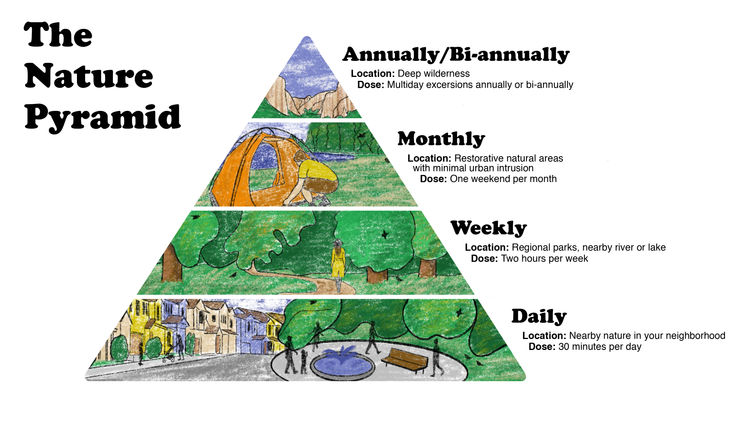
The next recommendation on the pyramid is a weekly outing to a park or someplace with a beautiful source of water. Being around water is extremely restorative, so it’s one of the top features in nature to look for when you’re feeling stressed.
Once a month, you should try to get away for a whole weekend. Ideally, have a fun excursion in a forested area.
The tip of the pyramid suggests that you take yearly or bi-yearly trips into the wilderness. These trips ought to be a more “intense” nature outing, like when Williams went kayaking on the Idaho Salmon River for six days with a group of veterans. One of the main takeaways from this book is that we need nature in all of these different kinds of doses. Williams says, “Humans have brains that are sensitive to social and emotional stress and we always have. Perhaps what matters is not the source of the stress but the ability to recover from it” (45).
Japan, Korea, Finland, Germany, America–Williams travels all over the world in order to understand how different cultures specifically appreciate nature. The idea of “forest bathing,” where people visit a forest to bask in nature, has caught on in all these countries and more.
Williams thoroughly evaluates how and why these different countries use forest bathing. Her depth and curiosity ought to encourage every journalist and writer to dig into their topics like Williams does. The number of places she visits and all the different people she interviews lend a well-rounded understanding of nature’s benefits.
Something I particularly appreciated about William’s work was her focus on how nature affects people with PTSD and ADHD. One of the last chapters is her interview at SOAR, a well-established camp and school for kids with ADHD and related learning disabilities. When I came upon this chapter for the first time, I was riveted by the in-depth look into why kids really shouldn’t be walled up indoors. Especially because me and my family have ADHD, I absorbed every word about how kids at this camp turned their restlessness into intrepid adventures through the woods.
According to the U.S. Centers for Disease Control and Prevention, 7.6 million children in America have a vitamin D deficiency. While this is the case for America, kids in Germany who go to “forest kindergarten,” or Waldkindergarten, tend to get sick less, and have healthier, more diverse micro bacteria (Williams, 235).
This chapter about kids thriving in nature makes you consider everything you’ve learned in the book previously; now that we know the details about how the brain prospers outdoors, we need to use those details to better everyone’s lives.
Concluding Thoughts
Nature gives us everything, but we don’t give much back. Everything we love about nature, all the things that help us relax and see the beauty in the world, need to be protected. “Until we all fully acknowledge the need for nature that’s driving some of our behavior, we won’t work to make it available for everyone” (Williams, 256).
The Nature Fix is truly a satisfying read. I think everybody knows deep in their bones more time in nature is good for us. However, this book satisfies the intellect in a way staring at a sunset cannot. By the end, I felt more whole for being able to understand (on some level) the intricacies between nature and humanity. The Nature Fix aims to reawaken our connection to what we call “outdoors,” “nature,” or “wilderness”–the place society has been slowly distancing itself from for a long time.
Williams uses The Nature Fix to offer useful insights and practical tips on how to improve your health with nature. This amazing resource also pushes for us to make change: more parks, more conservation, equal access to nature for all. If you’re a nature-lover and want to better advocate for it, or if you want to become a nature-lover, read this book. Fascinating research and gratifying answers await, and I’m sure you’ll want to read them for yourself.
Useful Insights from “The Nature Fix”:
- Follow the nature pyramid
- On urban walks, try to walk under trees, not through fields
- Humans’ favorite nature sounds are: wind, water, and birdsong; Listen to birdsong five minutes a day
- A survey of 3,000 Finnish residents revealed that spending five hours a month outdoors had the most significant emotional and restorative boosts (Williams, 139)
- Get a cypress essential oil to diffuse in your home to boost healthy white blood cells
- Noise pollution is another disruptive form of pollution; try to enjoy nature in the quietest place possible
“It’s not just the smell of a cypress, or the sound of the birds, or the color green that unlocks the pathway to health in our brains. We’re full sensory beings, or at least we were once built to be. Isn’t it possible that it’s only when you open all the doors–literally and figuratively–that the real magic happens?” (Williams, 127).
Additional Reading/Resources
- The experience of nature: A psychological perspective by Rachel and Stephan Kaplan Rachel and Stephan Kaplan’s work on Attention Restoration Theory, originally published in 1989.
- 18 Eco-Friendly Business Ideas A list of eco-friendly business ideas from howtostartanllc.com
- Welcoming Winter Wellness An article from Mother Earth Living about how we can embrace nature in winter
- Children and Nature Network. Helping Children Thrive – Outside | C&NN This organization advocates for more time in nature for children, tracks the research, and has a long list of abstracts that summarize studies on the subject
- What is Park Rx America A non-profit organization whose mission is to decrease the burden of chronic disease, increase health and happiness, and foster environmental stewardship, by virtue of prescribing Nature during the routine delivery of healthcare by a diverse group of health care professionals.
- Make Your Yard Wildlife-Friendly How to attract wildlife to your yard!
- #climate A resource to help you and your friends discover ways to fight climate change
- ReWild University – Unleash Your Inner Nature An educational resource on how to shift our culture into a more meaningful relationship with nature, self, and community


Leave a comment